---
title: "Ammonia revisited: carbon-free fertilizer, hydrogen carrier and fuel—from alleviating famines to contributing to a carbon free planet"
date: 2022-09-19T11:38:00-04:00
author: jessica napert
canonical_url: "https://www.bbaconsultants.com/en-ca/publications/ammonia-revisited-carbon-free-fertilizer-hydrogen-carrier-and-fuel"
section: Publications
---
Ammonia (NH3) has evolved from a key fertilizer, that historically helped alleviate past global famines, to becoming the most reliable and **carbon-free**hydrogen (H2) carrier that can be used for storing any colour hydrogen (grey, blue or green).


1. Ammonia synthesis technologies are known and reliable. With more than 100 years of history, they have been optimized and are now considered safe. They are preceded by a robust supply chain that is now being integrated and adapted to take green or blue hydrogen to produce green ammonia. The most widely used process to produce ammonia is the Haber-Bosch (HB) process.
    
    Traditionally, ammonia has been primarily produced by integrating either the steam methane reforming (SMR) process or the coal gasification or fuel oil oxidation processes. This produces the needed H2using the HB process. The SMR process generates more carbon dioxide (CO2) compared to any other chemical synthesis process. It emits around 2.4 tonnes of CO2 per tonne of product, more than steel (1.4 tonnes of CO2per tonne of steel) and 0.6 tonnes of CO2 per tonne of produced concrete. The SMR process only accounts for ~1.3% of global CO2emissions each year.
    
    Decarbonization will include producing green hydrogen and, as a result, will transform the SMR process-based units worldwide.
2. AMMONIA EMISSIONS OUTREACH
    
    In 2021, 235 million tonnes of ammonia were produced worldwide, making it the second highest-produced chemical commodity. It is extensively used for fertilizer, in air conditioning and refrigeration systems for large building units, in manufacturing explosives and textiles, in the pharmaceutical industry and as an absorption agent in acid gas removal. It accounts for around 2% (8.6 EJ) of the planet’s total net anthropogenic energy production.
    
    And there are further emerging uses for ammonia:
    
    
    - as an energy source in power generation, whether by direct combustion in gas turbines or as cracked ammonia in alkaline and proton exchange membrane (PEM) fuel cells.
    - as fuel for use in direct combustion engines, solid oxide fuel cells or PEM fuel cells.
    - as a medium for heat transfer.
    
    Direct emissions from ammonia production currently equal two thirds of Canada’s CO2 footprint.
3. REVIVING BENEFITS
    
    Comparable to H2 and methanol, ammonia is also a substance for energy storage. Abundant energy can be stored over long periods, allowing for optimized energy distribution. Ammonia can be in liquid form at -33°C at atmospheric pressure or at room temperature with pressures of around 10 bar, which is easier than with hydrogen. Liquid ammonia has a high H2 content of 17.8% by weight and an energy density of 13.77 MJ/L at 20oC and 8.6 bar. It is also comparatively more stable and convenient to transport than methanol.
4. SUPPLY CHAIN
    
    Liquid and gaseous ammonia have a well-established and high-capacity infrastructure for production and distribution, including tankage, pipelines, tank trucks, bunker shipping, overseas fleets and more. It also has well-defined regulations and a good safety history spanning more than a century. Ammonia is also far less flammable when exposed to air than is natural gas, methanol, hydrogen or gasoline vapours. While it is considerably more toxic than the aforementioned substances, safety protocols and best practices for its handling are already well established in the relevant industries.
5. ESTABLISHED TECHNOLOGIES AND OPTIONS
    
    Ammonia is mainly produced at commercial scale using the HB process, with technologies being developed to optimize it. This process produces ammonia from atmospheric nitrogen (N2) and H2using a metal catalyst at high temperature and pressure. Traditionally, H2is extracted from fossil fuels, as explained above.
    
    The HB process is well established. It consumes 8 MWh of energy per tonne of ammonia produced, with the natural gas reforming process for H2 production (where applicable), and accounts for ~75% of total energy demand. The remaining 25% is needed during ammonia synthesis, gas compression and ammonia separation. The H2 generation process accounts for 90% of CO2 emissions involved in the HB process, which, over the course of its evolution, has been subject to development and optimization that have increased its efficiency.
    
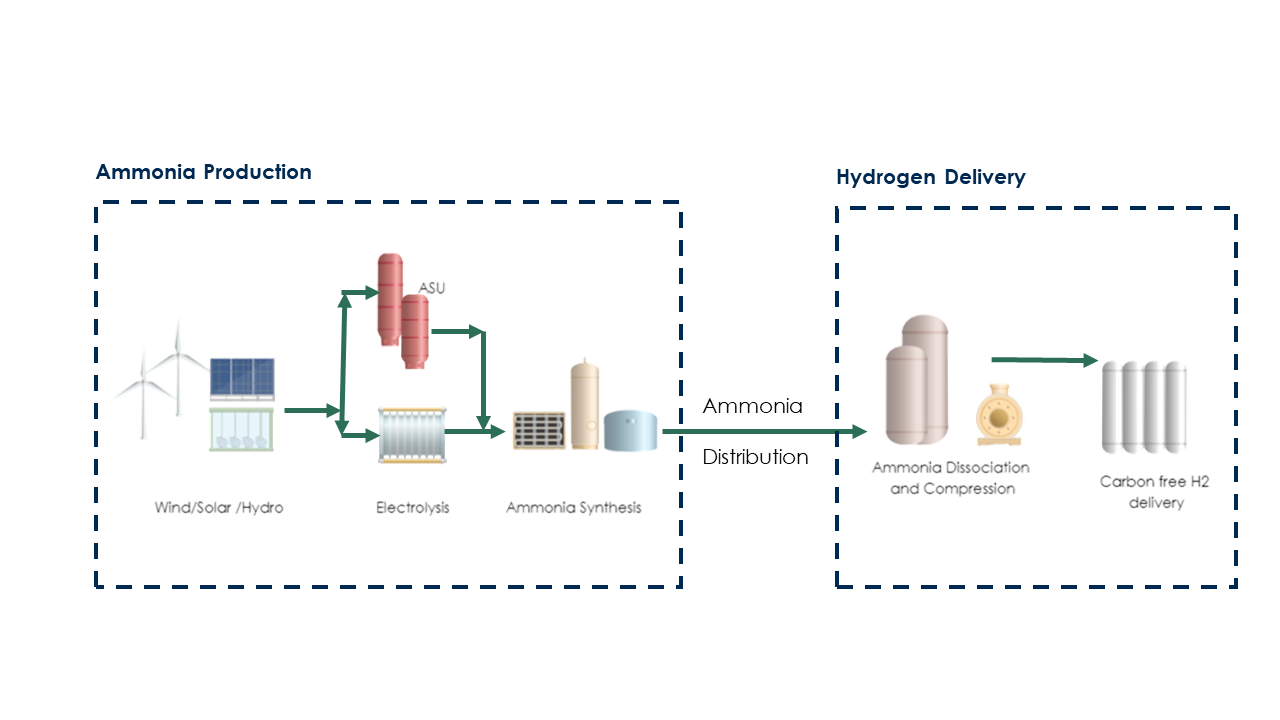
    Recent trends show that producing green hydrogen for all energy requirements is the only viable way to achieve deep decarbonization. The process uses water electrolysis and, ideally, renewable electrical sources to prevent the emissions generated by the SMR process.
    
    Another step to improve efficiency is by using water electrolysis technology based on solid oxide cells (SOC), recovering the heat released from the synthesis reaction to perform steam-based electrolysis.
    
    Alternative approaches to the HB process include electrochemical ammonia production and non-thermal plasma synthesis. These are promising technologies, but still need to reach commercially viable applicability.
6. COLOUR CODE
    
    With regard to the source of H2, ammonia is also referred to by a colour code. So far:
    
    
    - Brown ammonia is produced through the HB process using grey or brown H2, both of which imply fossil fuels as feedstock. Grey H2 is from natural gas using the SMR process, while brown H2 is created with coal gasification. Both H2colours emit CO2 during production and release it into the atmosphere. Brown ammonia accounts for most of the ammonia produced since the HB process started being implemented.
    - Blue ammonia is produced through the same methods as brown ammonia, but carbon capture and storage are incorporated into the traditional process to prevent CO2 from escaping into the atmosphere.
    - Green ammonia is produced using renewable, CO2-free energy sources, without the use of hydrocarbons. The H2 it uses as its prime raw material is produced through water electrolysis using 100% sustainable electricity sources. Green ammonia production also requires air separation units (ASUs) to produce N2.
7. AMMONIA EMISSIONS AND DIRECT AIR CAPTURE
    
    A side issue is the volatilization of NH3from agricultural systems and is the major anthropogenic source of atmospheric NH3, accounting for 10–30% of fertilizer nitrogen and animal excreta nitrogen. The issue becomes a valid concern when a fraction of the NH3can transform into N2O, another green house gas but with way more potential than CO2.
    
    A circular approach to green ammonia production should also include the recovery of emitted ammonia based on direct capture approaches.
8. CONCLUSION
    
    Ammonia production is currently a large contributor to global CO2 emissions due to its strong dependence on fossil fuels and the removal of all carbons in CO2 form. Major energy requirements, along with most CO2 emissions, occur from the H2production process, upon which ammonia synthesis relies. Green ammonia is therefore only feasible if H2 production is made fully dependent upon renewable energy sources. With that condition met, ammonia is a carbon-free alternative to hydrocarbons as an agent for carrying and storing energy.
    
    Existing technologies, infrastructure and policies make ammonia convenient and safe to transport. Moreover, increased research into energy efficiency is accelerating the development of technologies for green ammonia production. Areas of further research in the H2supply chain include cost reduction and better performance for electrolysers, H2storage and the transportation infrastructure.
9. [  ![Diapositive1](https://www.assets.bbaconsultants.com/bba-production-assets/production/images/Publications/Diapositive1.PNG)  ](https://www.assets.bbaconsultants.com/bba-production-assets/production/images/Publications/Diapositive1.PNG)
 
This content is for general information purposes only. All rights reserved ©BBA


    1. ![Ec employee men joe nava retouch web SQ LR BBA](https://www.assets.bbaconsultants.com/bba-production-assets/production/images/avatars/_size_avatar/204317/ec_employee_men_joe-nava_retouch_web_SQ_LR_BBA.webp)   
    
     Joe Nava, P.Eng.
    
    Global Director, Advanced Fuels and Chemicals
    
         Read bio   [  ](https://www.linkedin.com/in/joe-nava-4931a35/)  **For over 35 years, Joe Nava has been leveraging expertise to design and optimize complex processes in oil and gas, and advanced fuels and chemicals,** delivering reliable solutions that meet performance standards and stakeholder objectives.
    
    **Key expertise and certifications**
    
    
    - End-to-end engineering and delivery: conceptual, FEL-2/3/FEED, detailed design and EPC/EPCM
    - Technology integration and process optimization in refining, petrochemicals and gasification
    - Process definition and simulation, techno-economics and risk management
    - Technical leadership on international, multidisciplinary programs
    
    **Major achievements:** Led more than 100 projects in oil, gas and advanced fuels, including hydrogen, low carbon fuels and carbon solutions, delivered in international environments.
    
    **Approach and added value:** Joe transforms technical complexity into strategic levers, de-risking investments and supporting the energy transition by advancing profitable, sustainable energy projects.


    - [  27 Jul 2026 Mining and Metals  


     Early tailings decisions shape long-term mine performance 


    - ![Geraldine Cosset](https://www.assets.bbaconsultants.com/bba-production-assets/production/images/avatars/_size_avatar/206707/Geraldine-Cosset.webp)
    - ![Jared Purdy](https://www.assets.bbaconsultants.com/bba-production-assets/production/images/avatars/_size_avatar/212424/Jared-Purdy.webp)


      ](https://www.bbaconsultants.com/en-ca/insights/early-tailings-decisions-shape-long-term-mine-performance "Early tailings decisions shape long-term mine performance")
- [  02 Jul 2026 Mining and Metals  


     Python: A key tool for data analysis in mineral processing 


    - ![Charles Blais](https://www.assets.bbaconsultants.com/bba-production-assets/production/images/avatars/_size_avatar/211197/Charles-Blais.webp)
    - ![Juan Pablo Vergara](https://www.assets.bbaconsultants.com/bba-production-assets/production/images/avatars/_size_avatar/211266/Juan-Pablo-Vergara.webp)


      ](https://www.bbaconsultants.com/en-ca/insights/python-a-key-tool-for-data-analysis-in-mineral-processing "Python: A key tool for data analysis in mineral processing")
- [  19 Jun 2026 Mining and Metals  


     Speed is earned early in projects 


    - ![Mm employee men jean lheureux retouch web SQ LR BBA](https://www.assets.bbaconsultants.com/bba-production-assets/production/images/avatars/_size_avatar/204266/mm_employee_men_jean-lheureux_retouch_web_SQ_LR_BBA.webp)
    - ![Mm employee men benoit richard retouch web SQ LR BBA](https://www.assets.bbaconsultants.com/bba-production-assets/production/images/avatars/_size_avatar/203602/mm_employee_men_benoit-richard_retouch_web_SQ_LR_BBA.webp)


      ](https://www.bbaconsultants.com/en-ca/insights/speed-is-earned-early-in-projects "Speed is earned early in projects")
- [  17 Jun 2026 
    
     Industrial data platforms: building a solid foundation to optimize your operations 


    - ![Pierre Boucher](https://www.assets.bbaconsultants.com/bba-production-assets/production/images/avatars/_size_avatar/2671/Pierre-Boucher.webp)   
        
         Pierre Boucher, P.Eng.
        
        Senior Engineer, Operational Technology and Infrastructure


      ](https://www.bbaconsultants.com/en-ca/insights/industrial-data-platforms-building-a-solid-foundation-to-optimize-your-operations "Industrial data platforms: building a solid foundation to optimize your operations")


 [ See all 

 ](https://www.bbaconsultants.com/en-ca/insights "Go to Publications listing page") 


    - [  08 Oct 2025 Energy and Chemical Processes  


     Ammonia vs. dibenzyltoluene: A comparative assessment of hydrogen carriers 


    - ![Ec employee men joe nava retouch web SQ LR BBA](https://www.assets.bbaconsultants.com/bba-production-assets/production/images/avatars/_size_avatar/204317/ec_employee_men_joe-nava_retouch_web_SQ_LR_BBA.webp)   
        
         Joe Nava, P.Eng.
        
        Global Director, Advanced Fuels and Chemicals


      ](https://www.bbaconsultants.com/en-ca/publications/hydrogen-carriers-ammonia-vs-lohc "Ammonia vs. dibenzyltoluene: A comparative assessment of hydrogen carriers")


 [ See all 

 ](https://www.bbaconsultants.com/en-ca/insights) 


 Let’s  
think it further  
together [ Contact us    

 ](https://www.bbaconsultants.com/en-ca/contact) 


  Ammonia (NH3) has evolved from a key fertilizer, that historically helped alleviate past global famines, to becoming the most reliable and **carbon-free**hydrogen (H2) carrier that can be used for storing any colour hydrogen (grey, blue or green).


1. Ammonia synthesis technologies are known and reliable. With more than 100 years of history, they have been optimized and are now considered safe. They are preceded by a robust supply chain that is now being integrated and adapted to take green or blue hydrogen to produce green ammonia. The most widely used process to produce ammonia is the Haber-Bosch (HB) process.
    
    Traditionally, ammonia has been primarily produced by integrating either the steam methane reforming (SMR) process or the coal gasification or fuel oil oxidation processes. This produces the needed H2using the HB process. The SMR process generates more carbon dioxide (CO2) compared to any other chemical synthesis process. It emits around 2.4 tonnes of CO2 per tonne of product, more than steel (1.4 tonnes of CO2per tonne of steel) and 0.6 tonnes of CO2 per tonne of produced concrete. The SMR process only accounts for ~1.3% of global CO2emissions each year.
    
    Decarbonization will include producing green hydrogen and, as a result, will transform the SMR process-based units worldwide.
2. AMMONIA EMISSIONS OUTREACH
    
    In 2021, 235 million tonnes of ammonia were produced worldwide, making it the second highest-produced chemical commodity. It is extensively used for fertilizer, in air conditioning and refrigeration systems for large building units, in manufacturing explosives and textiles, in the pharmaceutical industry and as an absorption agent in acid gas removal. It accounts for around 2% (8.6 EJ) of the planet’s total net anthropogenic energy production.
    
    And there are further emerging uses for ammonia:
    
    
    - as an energy source in power generation, whether by direct combustion in gas turbines or as cracked ammonia in alkaline and proton exchange membrane (PEM) fuel cells.
    - as fuel for use in direct combustion engines, solid oxide fuel cells or PEM fuel cells.
    - as a medium for heat transfer.
    
    Direct emissions from ammonia production currently equal two thirds of Canada’s CO2 footprint.
3. REVIVING BENEFITS
    
    Comparable to H2 and methanol, ammonia is also a substance for energy storage. Abundant energy can be stored over long periods, allowing for optimized energy distribution. Ammonia can be in liquid form at -33°C at atmospheric pressure or at room temperature with pressures of around 10 bar, which is easier than with hydrogen. Liquid ammonia has a high H2 content of 17.8% by weight and an energy density of 13.77 MJ/L at 20oC and 8.6 bar. It is also comparatively more stable and convenient to transport than methanol.
4. SUPPLY CHAIN
    
    Liquid and gaseous ammonia have a well-established and high-capacity infrastructure for production and distribution, including tankage, pipelines, tank trucks, bunker shipping, overseas fleets and more. It also has well-defined regulations and a good safety history spanning more than a century. Ammonia is also far less flammable when exposed to air than is natural gas, methanol, hydrogen or gasoline vapours. While it is considerably more toxic than the aforementioned substances, safety protocols and best practices for its handling are already well established in the relevant industries.
5. ESTABLISHED TECHNOLOGIES AND OPTIONS
    
    Ammonia is mainly produced at commercial scale using the HB process, with technologies being developed to optimize it. This process produces ammonia from atmospheric nitrogen (N2) and H2using a metal catalyst at high temperature and pressure. Traditionally, H2is extracted from fossil fuels, as explained above.
    
    The HB process is well established. It consumes 8 MWh of energy per tonne of ammonia produced, with the natural gas reforming process for H2 production (where applicable), and accounts for ~75% of total energy demand. The remaining 25% is needed during ammonia synthesis, gas compression and ammonia separation. The H2 generation process accounts for 90% of CO2 emissions involved in the HB process, which, over the course of its evolution, has been subject to development and optimization that have increased its efficiency.
    
    Recent trends show that producing green hydrogen for all energy requirements is the only viable way to achieve deep decarbonization. The process uses water electrolysis and, ideally, renewable electrical sources to prevent the emissions generated by the SMR process.
    
    Another step to improve efficiency is by using water electrolysis technology based on solid oxide cells (SOC), recovering the heat released from the synthesis reaction to perform steam-based electrolysis.
    
    Alternative approaches to the HB process include electrochemical ammonia production and non-thermal plasma synthesis. These are promising technologies, but still need to reach commercially viable applicability.
6. COLOUR CODE
    
    With regard to the source of H2, ammonia is also referred to by a colour code. So far:
    
    
    - Brown ammonia is produced through the HB process using grey or brown H2, both of which imply fossil fuels as feedstock. Grey H2 is from natural gas using the SMR process, while brown H2 is created with coal gasification. Both H2colours emit CO2 during production and release it into the atmosphere. Brown ammonia accounts for most of the ammonia produced since the HB process started being implemented.
    - Blue ammonia is produced through the same methods as brown ammonia, but carbon capture and storage are incorporated into the traditional process to prevent CO2 from escaping into the atmosphere.
    - Green ammonia is produced using renewable, CO2-free energy sources, without the use of hydrocarbons. The H2 it uses as its prime raw material is produced through water electrolysis using 100% sustainable electricity sources. Green ammonia production also requires air separation units (ASUs) to produce N2.
7. AMMONIA EMISSIONS AND DIRECT AIR CAPTURE
    
    A side issue is the volatilization of NH3from agricultural systems and is the major anthropogenic source of atmospheric NH3, accounting for 10–30% of fertilizer nitrogen and animal excreta nitrogen. The issue becomes a valid concern when a fraction of the NH3can transform into N2O, another green house gas but with way more potential than CO2.
    
    A circular approach to green ammonia production should also include the recovery of emitted ammonia based on direct capture approaches.
8. CONCLUSION
    
    Ammonia production is currently a large contributor to global CO2 emissions due to its strong dependence on fossil fuels and the removal of all carbons in CO2 form. Major energy requirements, along with most CO2 emissions, occur from the H2production process, upon which ammonia synthesis relies. Green ammonia is therefore only feasible if H2 production is made fully dependent upon renewable energy sources. With that condition met, ammonia is a carbon-free alternative to hydrocarbons as an agent for carrying and storing energy.
    
    Existing technologies, infrastructure and policies make ammonia convenient and safe to transport. Moreover, increased research into energy efficiency is accelerating the development of technologies for green ammonia production. Areas of further research in the H2supply chain include cost reduction and better performance for electrolysers, H2storage and the transportation infrastructure.
9. [  ![Diapositive1](https://www.assets.bbaconsultants.com/bba-production-assets/production/images/Publications/Diapositive1.PNG)  ](https://www.assets.bbaconsultants.com/bba-production-assets/production/images/Publications/Diapositive1.PNG)
 
This content is for general information purposes only. All rights reserved ©BBA