---
title: "Integrating a renewable energy source into mining: six key steps"
date: 2019-08-15T15:00:00-04:00
author: jessica napert
canonical_url: "https://www.bbaconsultants.com/en-ca/publications/integrating-a-renewable-energy-source-into-mining-six-key-steps"
section: Publications
---
If you’re thinking about integrating a renewable energy source to power your remote mining operation and lower your fuel costs, you’re probably asking yourself a slew of questions… and with reason: What technology should you choose? What kind of real impact will it have on your system? What fuel savings can you expect?

This article will help you understand how using a renewable energy source can make your mining installations operate more efficiently.


1. ## Step 1 – Understanding your operations
    
    If you want to know how significant a renewable energy source can be for your operations, you first need to have details about your operations and installations, particularly what is installed and how it operates.
    
    What you have to determine first:
    
    
    - What are your largest loads?
    - What are your peak power demands?
    - Do you have a need for thermal energy?
    - Do your process and power plant operators communicate?
    - What is the power plant operating strategy?
    - What is your load shedding strategy?
    
    This will lay the groundwork so you can start building a business case and understand the impact integrating a renewable energy source will have on your finances and operations.
    
    ## Step 2 – Understanding your limits
    
    Then, you need to know your network limitations. Today’s renewable energy technologies have power quality limitations that can restrict your operations.
    
    Ultimately, integrating renewables into your energy mix:
    
    
    - Limits the available fault level (short-circuit)
    - Reduces reactive power availability
    - Affects frequency stability and voltage regulation
    - Reduces heat recovery
    - Inherently increases spinning reserves
    
    The most important element to recognize is that large renewable penetration is restricted by short-circuit limits that must be respected on your electrical network to prevent equipment damage and injury. This is typically controlled by maintaining a minimum threshold of reciprocating engine energy contribution to the network or by using synchronous condensers. In both cases, important technical and economic factors must be considered.
    
    ## Step 3 – Understanding your resources
    
    You then need to understand your renewable energy resources.
    
    
    - What is the wind potential at your location?
    - What are the insolation levels?
    - Is there hydro potential?
    
    You can get most answers using online data; however, without local measurements, the level of uncertainty will remain high. The following graph illustrates variations across online wind resources for the same physical location:
2. [  ![Blog Body Image JP Castonguay 6 steps renewables mining EN 1](https://www.assets.bbaconsultants.com/bba-production-assets/production/images/Publications/Blog-Body-Image-JPCastonguay-6-steps-renewables-mining-EN_1.png) Figure 1 - Wind integration into an off-grid network  ](https://www.assets.bbaconsultants.com/bba-production-assets/production/images/Publications/Blog-Body-Image-JPCastonguay-6-steps-renewables-mining-EN_1.png)
3. This illustrates that, for the same study, using different sources of information can change your fuel displacement quantity by 20%, which can dramatically change the financial viability of the project.
    
    With regard to insolation, although solar data collected via satellite is fairly accurate, understanding cloud cover fluctuations helps evaluate actual impacts from the power variability. It is also important to collect at least one year’s worth of data to fully understand the effects of seasonal variations.
    
    ## Step 4 – Building your business case
    
    The preceding elements are then collected to effectively model your network and build a business case that identifies a technical and economic sweet spot. This helps you select an informed and low-risk investment that meets your needs.
4. [  ![Blog Body Image JP Castonguay 6 steps renewables mining EN 2](https://www.assets.bbaconsultants.com/bba-production-assets/production/images/Publications/Blog-Body-Image-JPCastonguay-6-steps-renewables-mining-EN_2.png) Figure 2 - Renewable cost and litres of fuel displaced per installed capacity  ](https://www.assets.bbaconsultants.com/bba-production-assets/production/images/Publications/Blog-Body-Image-JPCastonguay-6-steps-renewables-mining-EN_2.png)
5. The figure above illustrates that, at some point, more investment will not generate better value. You will reach a plateau where renewable energy added to the network will eventually produce less impact on fuel displacement.
    
    ## Step 5 – Choosing a deployment plan
    
    At this point, the stage is set. The question now will be how and when to deploy your renewable installations.
    
    The answer depends on many factors, particularly:
    
    
    - How much risk are you willing to take?
    - What is your available capital?
    - How much change are you willing to bring to your operation?
    
    Typically, a cautious approach is to first learn about your operation and then phase renewables into your network. This approach, unlike any radical changes, will limit risks affecting power stability and disrupting your production.
    
    ## Step 6 – Improving continuously
    
    Keep in mind that your renewable system will not be optimal on day one. The initial operation will be conservative to properly manage electrical power generation and maintain your network power reliability.
    
    Also, until you are confident with your system, expect large spinning reserves and possibly curtailment from your renewable network. Over time, you can tweak, improve and optimize operation to its full potential.
    
    Value improvements can also be integrated as capital becomes available, if not carried out at the beginning. This includes adding predictive meteorology stations to better manage spinning reserve or incorporating battery storage.
    
    ## In conclusion
    
    At the moment, many remote mines are considering integrating renewable energy into their networks. Count on BBA to help you make the right choices.
 
This content is for general information purposes only. All rights reserved ©BBA


    1. ![Jean-Philippe Castonguay](https://www.assets.bbaconsultants.com/bba-production-assets/production/images/avatars/_size_avatar/3304/Jean-Philippe-Castonguay.webp)   
    
     Jean-Philippe Castonguay, P.Eng.
    
    Director - Off-Grid Hybrid Power &amp; Energy Storage
    
         [  ](https://www.linkedin.com/in/jpcastonguay/)


    - [  27 Jul 2026 Mining and Metals  


     Early tailings decisions shape long-term mine performance 


    - ![Geraldine Cosset](https://www.assets.bbaconsultants.com/bba-production-assets/production/images/avatars/_size_avatar/206707/Geraldine-Cosset.webp)
    - ![Jared Purdy](https://www.assets.bbaconsultants.com/bba-production-assets/production/images/avatars/_size_avatar/212424/Jared-Purdy.webp)


      ](https://www.bbaconsultants.com/en-ca/insights/early-tailings-decisions-shape-long-term-mine-performance "Early tailings decisions shape long-term mine performance")
- [  02 Jul 2026 Mining and Metals  


     Python: A key tool for data analysis in mineral processing 


    - ![Charles Blais](https://www.assets.bbaconsultants.com/bba-production-assets/production/images/avatars/_size_avatar/211197/Charles-Blais.webp)
    - ![Juan Pablo Vergara](https://www.assets.bbaconsultants.com/bba-production-assets/production/images/avatars/_size_avatar/211266/Juan-Pablo-Vergara.webp)


      ](https://www.bbaconsultants.com/en-ca/insights/python-a-key-tool-for-data-analysis-in-mineral-processing "Python: A key tool for data analysis in mineral processing")
- [  19 Jun 2026 Mining and Metals  


     Speed is earned early in projects 


    - ![Mm employee men jean lheureux retouch web SQ LR BBA](https://www.assets.bbaconsultants.com/bba-production-assets/production/images/avatars/_size_avatar/204266/mm_employee_men_jean-lheureux_retouch_web_SQ_LR_BBA.webp)
    - ![Mm employee men benoit richard retouch web SQ LR BBA](https://www.assets.bbaconsultants.com/bba-production-assets/production/images/avatars/_size_avatar/203602/mm_employee_men_benoit-richard_retouch_web_SQ_LR_BBA.webp)


      ](https://www.bbaconsultants.com/en-ca/insights/speed-is-earned-early-in-projects "Speed is earned early in projects")
- [  17 Jun 2026 
    
     Industrial data platforms: building a solid foundation to optimize your operations 


    - ![Pierre Boucher](https://www.assets.bbaconsultants.com/bba-production-assets/production/images/avatars/_size_avatar/2671/Pierre-Boucher.webp)   
        
         Pierre Boucher, P.Eng.
        
        Senior Engineer, Operational Technology and Infrastructure


      ](https://www.bbaconsultants.com/en-ca/insights/industrial-data-platforms-building-a-solid-foundation-to-optimize-your-operations "Industrial data platforms: building a solid foundation to optimize your operations")


 [ See all 

 ](https://www.bbaconsultants.com/en-ca/insights "Go to Publications listing page") 


 Let’s  
think it further  
together [ Contact us    

 ](https://www.bbaconsultants.com/en-ca/contact) 


  If you’re thinking about integrating a renewable energy source to power your remote mining operation and lower your fuel costs, you’re probably asking yourself a slew of questions… and with reason: What technology should you choose? What kind of real impact will it have on your system? What fuel savings can you expect?

This article will help you understand how using a renewable energy source can make your mining installations operate more efficiently.


1. ## Step 1 – Understanding your operations
    
    If you want to know how significant a renewable energy source can be for your operations, you first need to have details about your operations and installations, particularly what is installed and how it operates.
    
    What you have to determine first:
    
    
    - What are your largest loads?
    - What are your peak power demands?
    - Do you have a need for thermal energy?
    - Do your process and power plant operators communicate?
    - What is the power plant operating strategy?
    - What is your load shedding strategy?
    
    This will lay the groundwork so you can start building a business case and understand the impact integrating a renewable energy source will have on your finances and operations.
    
    ## Step 2 – Understanding your limits
    
    Then, you need to know your network limitations. Today’s renewable energy technologies have power quality limitations that can restrict your operations.
    
    Ultimately, integrating renewables into your energy mix:
    
    
    - Limits the available fault level (short-circuit)
    - Reduces reactive power availability
    - Affects frequency stability and voltage regulation
    - Reduces heat recovery
    - Inherently increases spinning reserves
    
    The most important element to recognize is that large renewable penetration is restricted by short-circuit limits that must be respected on your electrical network to prevent equipment damage and injury. This is typically controlled by maintaining a minimum threshold of reciprocating engine energy contribution to the network or by using synchronous condensers. In both cases, important technical and economic factors must be considered.
    
    ## Step 3 – Understanding your resources
    
    You then need to understand your renewable energy resources.
    
    
    - What is the wind potential at your location?
    - What are the insolation levels?
    - Is there hydro potential?
    
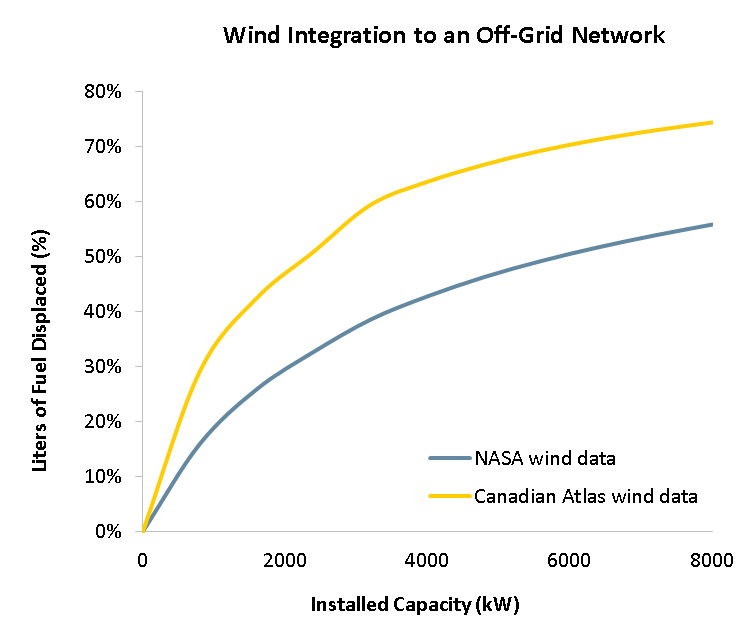
    You can get most answers using online data; however, without local measurements, the level of uncertainty will remain high. The following graph illustrates variations across online wind resources for the same physical location:
2. [  ![Blog Body Image JP Castonguay 6 steps renewables mining EN 1](https://www.assets.bbaconsultants.com/bba-production-assets/production/images/Publications/Blog-Body-Image-JPCastonguay-6-steps-renewables-mining-EN_1.png) Figure 1 - Wind integration into an off-grid network  ](https://www.assets.bbaconsultants.com/bba-production-assets/production/images/Publications/Blog-Body-Image-JPCastonguay-6-steps-renewables-mining-EN_1.png)
3. This illustrates that, for the same study, using different sources of information can change your fuel displacement quantity by 20%, which can dramatically change the financial viability of the project.
    
    With regard to insolation, although solar data collected via satellite is fairly accurate, understanding cloud cover fluctuations helps evaluate actual impacts from the power variability. It is also important to collect at least one year’s worth of data to fully understand the effects of seasonal variations.
    
    ## Step 4 – Building your business case
    
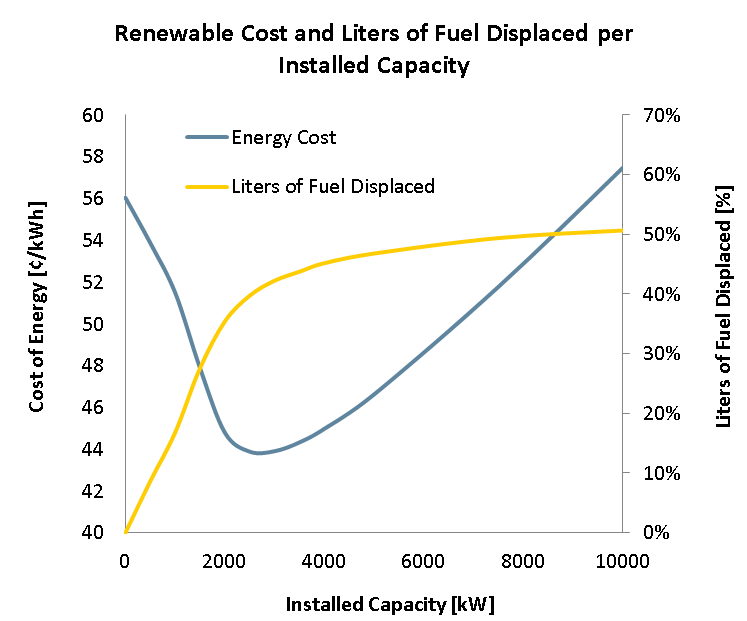
    The preceding elements are then collected to effectively model your network and build a business case that identifies a technical and economic sweet spot. This helps you select an informed and low-risk investment that meets your needs.
4. [  ![Blog Body Image JP Castonguay 6 steps renewables mining EN 2](https://www.assets.bbaconsultants.com/bba-production-assets/production/images/Publications/Blog-Body-Image-JPCastonguay-6-steps-renewables-mining-EN_2.png) Figure 2 - Renewable cost and litres of fuel displaced per installed capacity  ](https://www.assets.bbaconsultants.com/bba-production-assets/production/images/Publications/Blog-Body-Image-JPCastonguay-6-steps-renewables-mining-EN_2.png)
5. The figure above illustrates that, at some point, more investment will not generate better value. You will reach a plateau where renewable energy added to the network will eventually produce less impact on fuel displacement.
    
    ## Step 5 – Choosing a deployment plan
    
    At this point, the stage is set. The question now will be how and when to deploy your renewable installations.
    
    The answer depends on many factors, particularly:
    
    
    - How much risk are you willing to take?
    - What is your available capital?
    - How much change are you willing to bring to your operation?
    
    Typically, a cautious approach is to first learn about your operation and then phase renewables into your network. This approach, unlike any radical changes, will limit risks affecting power stability and disrupting your production.
    
    ## Step 6 – Improving continuously
    
    Keep in mind that your renewable system will not be optimal on day one. The initial operation will be conservative to properly manage electrical power generation and maintain your network power reliability.
    
    Also, until you are confident with your system, expect large spinning reserves and possibly curtailment from your renewable network. Over time, you can tweak, improve and optimize operation to its full potential.
    
    Value improvements can also be integrated as capital becomes available, if not carried out at the beginning. This includes adding predictive meteorology stations to better manage spinning reserve or incorporating battery storage.
    
    ## In conclusion
    
    At the moment, many remote mines are considering integrating renewable energy into their networks. Count on BBA to help you make the right choices.
 
This content is for general information purposes only. All rights reserved ©BBA