Conclusion
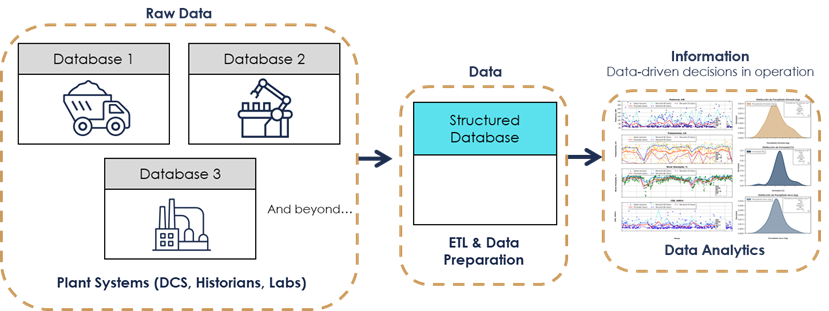
Modern mining demands the ability to interpret large volumes of plant data quickly to make accurate, timely decisions. Python has proven to be a powerful tool for automating analysis, reducing manual effort and improving the consistency and depth of operational insights. When properly structured, data-driven workflows allow engineers to focus less on repetitive tasks and more on diagnosing process behaviour, identifying optimization opportunities and supporting reliable metallurgical decision-making.
The impact of these methodologies grows significantly when combined with process expertise, operational context and a rigorous analytical framework. At BBA, multidisciplinary collaboration is essential to this approach. Our process engineers, metallurgists and automation specialists work together to ensure that analytical tools integrate seamlessly with plant realities, control strategies and operational objectives. This synergy enables us to design solutions that not only analyze data but also strengthen decision-making and enhance day‑to‑day plant performance.
These integrated solutions increase both the efficiency and effectiveness of our clients’ operations, ensuring that high‑quality information is always available to guide operational improvements. Although this article focuses on data analytics rather than sustainability, it’s worth noting that improved operational stability and optimized process control can directly contribute to more energy‑efficient mineral processing.
Looking forward, the industry is moving toward real‑time data intelligence, advanced automation and predictive modelling, topics that will be explored in future publications. Python provides a robust foundation for that evolution, and BBA is ready to support operations at every step, from data strategy and automation to advanced analytics and metallurgical optimization.